- Release
- 02/2026
- Publisher
- Piatnik
- Designers
- Ségolène & Jean-Paul Monnet
- Languages
- Czech, English, French, German
- Age
- 7+
- Illustrators
- Lars Besten
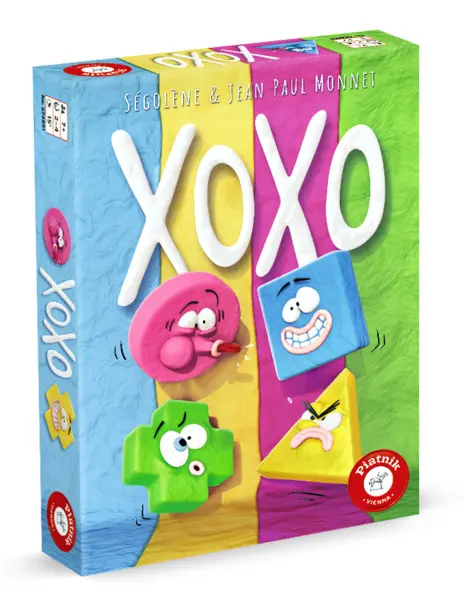
The entertaining family game “Xoxo” from the Viennese games publisher Piatnik is all about colours, shapes and facial expressions. Based on the familiar Noughts and Crosses concept, three elements of the same type must form a horizontal, vertical or diagonal line. But it’s not quite as easy as it sounds: each of the two to four players (aged seven and over) has several secret missions to complete. As the players share a common board, it’s easy to get in each other’s way on the 3x3 grid of tiles. If you’re not careful, you might even unwittingly help your opponents to a quick victory.
48 square tiles and 12 objective cards to hold in your hand: that’s all the compact game ‘Xoxo’ needs to provide hours of fun and tactical enjoyment. Based on the familiar Tic-Tac-Toe concept but enhanced with clever details and slight variations to the rules, this popular classic is transformed into a tricky guessing game with a refreshingly colourful and humorously illustrated design.
The tiles are divided into personal stacks and an additional communal stack in the centre of the table. The objective cards show the respective secret missions: colours, shapes or various facial expressions. But be careful: the back of the cards reveals a crucial clue, so that players can keep an eye not only on their own missions but also on those of the others.
On their turn, a player places either a tile from their own stack or from the communal stack onto the shared display. The rule is: new tiles must be placed horizontally or vertically adjacent to a tile already on display, and the grid must not exceed 3 x 3. Once there are 9 tiles on the table, any further tiles are placed on top of those already there and are thus covered. The only exception is that the tile placed immediately beforehand is spared. If a player fulfils an objective card through skilful placement (or by observing what others are doing), it is placed face up. Play continues in this way until either one player fulfils their last objective card and thus wins the game, or any one stack of tiles is exhausted. In this case, the winner is the player who has currently fulfilled the most objective cards. The short playing time of around 15 minutes makes for quick rematches.